Part 1. You're Already Paying for Automation..You're Just Paying Too Much for It.
Somewhere in your town hall, there is a filing cabinet. On top of it, almost certainly, is a stack of paper that shouldn't be paper anymore. And somewhere in your budget, probably across four or five line items scattered across three departments, you are paying a software vendor a great deal of money to help with that stack.

How's that going?
This series is about affordable automation for small local governments, and I want to start with the uncomfortable thing first: most small governments are not automation beginners. You've been sold to, you've signed contracts... You've sat through the demos where someone in a quarter-zip said the word "seamless" at least nine times. You own software. The question isn't whether to start automating. The question is why you're paying enterprise-tier prices for tools your town of 10,000 uses at only about 4% of their capacity.
The patterns that drain small-government budgets
Once you start looking, they're everywhere.
There's the five-year contract signed two administrations ago that auto-renews every July before anyone remembers to look at it. There's the per-seat pricing on a platform where a third of the seats belong to people who left in 2022 — and nobody told the vendor, because nobody knew they were supposed to. There are the modules you're paying extra for those duplicate capabilities already included in the Microsoft 365 or Google Workspace license sitting right next to them on your invoice. There are bundled products where you're paying for nine features to get the one you wanted, because the vendor doesn't sell that feature on its own. And there's the classic — software that requires paid professional services engagement every time you want to add a checkbox to a form. $180 an hour. Two-hour minimum. Six weeks out.
You didn't do anything wrong. Small governments are, from a vendor's perspective, a peculiar customer: too small to get the sales-engineering attention that catches these mismatches, too large to be ignored entirely, and almost always short on the one resource that would solve the problem, which is a staff member whose full-time job is to stay on top of the software. So, things drift. Contracts renew. Prices creep. Features stay switched off because nobody had an afternoon to figure out how to switch them on.
The costs that aren't on the invoice
The line-item price is only the visible part. The real cost of mis-bought automation is the stuff nobody puts in a spreadsheet.
Staff time spent working around clunky software is a cost. Training three new employees a year onto a system that takes six weeks to learn and that nobody on staff fully understands is a cost. Paying a vendor's implementation team $180 an hour to make a change you could have made yourself if the software had been designed for you is a cost. Losing a grant because the reporting export doesn't produce the format the state requires; that is a very large cost, and it never shows up on the software invoice at all. Neither does the resident who gave up on the online permit portal and just drove down to city hall, where your one available staff member is now spending twenty minutes helping them instead of doing the thing they were hired to do.
When small governments tally the real number — the invoice plus the friction plus the workarounds plus the opportunity costs — the "automation" they already own frequently costs more per useful outcome than thoughtfully chosen alternatives would. Sometimes dramatically more.
The reframe
Here's where this series is going, and it's probably not where you expect.
Affordable automation for small local governments is not primarily about buying new tools. That's the part the vendors want you to focus on, because the part the vendors want you to focus on is always the part where you give them more money. The real work — the work that actually moves the needle for a town of 8,000 or a county of 40,000 — is threefold: get honest value from what you already own, cut what you don't need, and become a much smarter buyer the next time someone walks into council chambers with a slide deck and a three-year term sheet.
The next nine posts are a field guide for doing exactly that. We'll start by auditing your current inventory (you will find things). We'll walk through the automation capabilities already included in software you've been paying for all along (you will find more things). We'll get practical about genuinely affordable tools that fill real gaps. We'll talk about picking the first automation project you can actually finish. And by the time we get to the post on procurement, you'll recognize half the traps before the vendor finishes the opening slide.
Your homework before the next post
One small, concrete thing. Before Post 2 lands, pull your software contracts — all of them, including the ones tucked inside other departments' budgets. For each one, write down three pieces of information: what it costs per year, when it renews, and the last time anyone on staff said a kind word about it.
That list is the real starting point for this series. It's also, not coincidentally, the single most valuable document you can put in front of your council in the next budget cycle. Most small governments have never assembled it. The ones that do usually find the first five figures of savings before they get to the bottom of the page.
See you in Part 2.
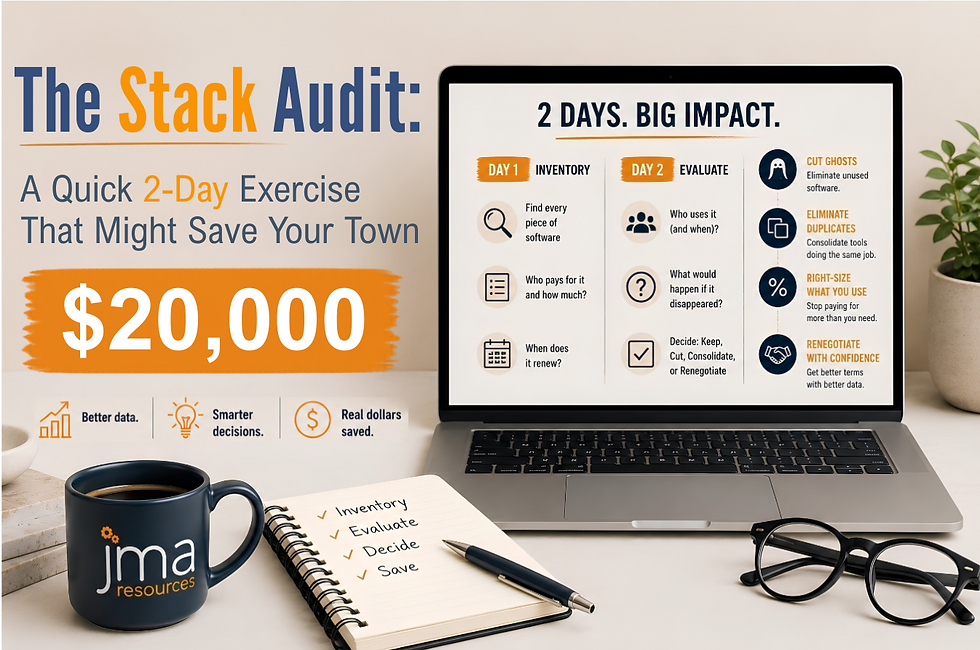
Next up: The Stack Audit: A Weekend Exercise That Might Save Your Town $20,000.
About the Author: Layne Thompson is Senior Vice President at JMA Resources, Inc., where he leads Growth, Innovation, Research, and Development initiatives. With more than 30 years of experience spanning military service, federal leadership, private industry, and local government, he is passionate about helping communities implement practical, cost-effective technology solutions that deliver real results.
Layne previously served as Borough Manager for the Borough of Mechanicsburg, Pennsylvania, from December 2022 through December 2025.